A Submariner’s Guide to What’s in the Book
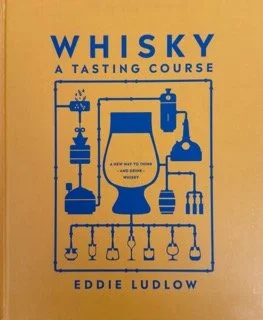
🥃 Whisky: A Tasting Course (Eddie Ludlow)
There’s a moment in every whisky journey where something clicks.
You realise you’ve been drinking whisky…
but you haven’t really been tasting it.
Eddie Ludlow’s Whisky: A Tasting Course isn’t just a book — it’s a training manual. The kind that takes you from the surface level of “that tastes good” to a disciplined, confident understanding of what’s actually happening in your glass.
Think of it less like casual sipping…
and more like qualifying your senses for duty.
⚓ Phase One: Basic Training — Control the Environment
Before anything else, you need control.
Most people hit whisky like a wave — too fast, too hard — and all they get is alcohol burn. Ludlow starts by teaching restraint and method.
You learn to:
Approach the nose with short, controlled passes
Break tasting into clear stages: arrival, development, finish
Use water with purpose — to open up flavour, not drown it
This is your foundation. No shortcuts.
Because until you control the environment, you can’t interpret what you’re detecting.
🌍 Mapping the Depths: Understanding Whisky Styles
Once you’ve got control, it’s time to understand where you are.
Different whisky styles aren’t just labels — they’re operating conditions.
Ludlow introduces the major styles not as categories to memorise, but as systems to understand.
Smoky, medicinal notes? You’re dealing with peat influence
Vanilla and caramel? That’s charred oak doing its job
Light and delicate? Likely triple distillation or subtle maturation
You begin to see whisky as a chain of cause and effect:
ingredients → process → flavour
And once you understand that, tasting becomes less guesswork and more of a discovery.
You’re no longer guessing — you’re identifying.
👃 Phase Three: Sensor Calibration — Training the System
Now the real work begins.
Your senses need calibration, just like any critical system.
Through structured comparisons, you start identifying core flavour groups:
Fruity
Floral
Spicy
Woody
Peaty
Cereal
And here’s where most people go wrong—they chase exact tasting notes.
Ludlow’s method is different.
He trains recognition, not performance.
Because once your palate is calibrated, you don’t need to search for flavours.
You detect them.
⚙️ Phase Four: The 20-Exercise Program
At the core of the book is a series of 20 structured tastings.
Each one is deliberate. Each one builds on the last.
You move through:
Light vs rich profiles
Bourbon vs Scotch
Peated vs unpeated
Sherry cask influence
Age and complexity
It’s systematic training—not random sampling.
Two whiskies, compared properly, will teach you more than ten ever will casually.
Finding every exact whisky used in the book would be extremely difficult and expensive, so I have approached it by sourcing what I can to match each exercise as closely as possible. This is still an ongoing process, and is best to be treated as a marathon, not a sprint.
🧠 Phase Five: Owning Your Assessment — Trust Your Readings
By this stage, you’re no longer relying on outside influence — you’re backing your own judgement.
You move away from:
• Price tags
• Age statements
• Reputation
And start focusing on what your senses are actually telling you.
This is where many people fall into the trap of “status whisky”— chasing what they think they should like.
Ludlow’s approach cuts through that.
Because a well-trained palate doesn’t need validation.
It needs honesty.
And the real question becomes:
What am I detecting — and do I genuinely enjoy it?
🎯 The Final Takeaway: The Submariner’s Mindset
This book doesn’t try to make you an expert overnight.
It does something far more useful:
It builds discipline
It sharpens awareness
It develops confidence
You come away not with memorised notes, but with a reliable system.
🥃 A Philosophy Worth Keeping
You’re not here to criticise.
You’re not here to show off.
You’re here to:
Learn
Observe
Understand
Because the truth is —
The depth of whisky isn’t in the bottle.
It’s in how you experience it.
Worth a read.